Translation Services
Accurate, consistent, and culturally precise translation for legal, education, and nonprofit organizations. AI-assisted tools and expert human linguists at every stage, delivered in documents that match your original layout.
A mistranslated IEP, an inaccurate consent form, or a misrendered legal document is not corrected with a revision. It is managed with a legal response.
Translation has changed. Modern workflows that combine machine translation with expert human review are faster and more consistent than traditional human-only pipelines, and when managed correctly they deliver professional-grade quality for many document types. At AccessBridge, we use these tools deliberately and transparently: AI and machine translation provide a working foundation, and qualified linguists review, edit, and validate every segment before anything reaches you.
This approach is called Machine Translation Post-Editing, or MTPE. It is the current professional standard in the translation industry, and it is how responsible translation providers work at scale without sacrificing quality. What it is not is unreviewed machine output. A translation that leaves our workflow has been touched by a human linguist who is accountable for its accuracy, cultural appropriateness, and terminological consistency.
The result is translation that is faster and more cost-effective than traditional methods, without trading the accuracy and consistency your documents require. Human-only translation, with no machine translation at any stage, is also available for any project, and it is our recommended workflow for highly sensitive content.

Translated documents that look the way they should
Translation produces accurate text. Multilingual desktop publishing (mDTP) produces a finished document. These are not the same thing.
When a translated document is delivered as a plain text file or a roughly reformatted Word export, the recipient’s organization must still place that text into the original design — a step that is frequently skipped, producing materials that look unprofessional or are functionally unusable. AccessBridge handles this step as part of the production workflow for any document where visual layout is part of the deliverable.
File formats we work in:
- Microsoft Word (.docx) — including documents with complex table structures, headers, footers, and tracked changes
- Microsoft PowerPoint (.pptx) — slide-by-slide layout preservation across all major language pairs
- Adobe InDesign (.indd) — professional print and publication layouts, including brochures, booklets, and formal reports
- Canva — exported and reimported with translated text placed into original design templates
- PDF — for documents requiring layout-faithful output without editable source files
What mDTP resolves
Spanish text typically expands 20 to 30 percent relative to English. Arabic and Hebrew require right-to-left text flow. Chinese, Japanese, and Korean require different font stacks than Latin-script languages. A translation workflow that does not account for these realities delivers text that breaks its own layout. Our mDTP step catches and resolves all of these before the document reaches you.
Every language also has its own typesetting conventions, and applying them requires a specialist who reads the language. Polish and Czech keep one-letter prepositions and conjunctions with the word that follows them, so a line never ends on one. French spaces punctuation differently from English. Chinese and Japanese restrict which punctuation marks may begin or end a line. Vietnamese needs added line spacing for stacked tone marks. Our mDTP step applies these conventions, and a linguist who reads the target language reviews the typeset result before delivery.
Our translation workflow
Step 1: Project Assessment
Every project begins with a human assessment. Our project managers review the source document, identify subject matter, flag terminology requirements, assess complexity, and recommend the appropriate workflow: full MTPE, light post-editing, or human-only translation. You can also request human-only translation for any project. No document enters production without this step.
Step 2: Translation Memory and Term base Application
Before any translation begins, we apply your project’s translation memory (TM) — a database of previously approved translations — and term base, a controlled vocabulary of approved terms for your organization or subject matter. This ensures consistency across documents, across linguists, and over time. If you are a recurring client, your TM grows with every project, reducing cost and improving consistency on each subsequent engagement.
Step 3: AI-Assisted Translation with MTPE
For most document types, a machine translation engine produces an initial draft, which a qualified linguist then reviews segment by segment — correcting errors, improving fluency, resolving ambiguities, and ensuring that the translation reads naturally in the target language rather than like translated text. The linguist is not reviewing a finished product. They are editing a draft with full accountability for the final output.
For highly complex, sensitive, or specialized content — legal arguments, psychological evaluations, informed consent documents, and materials where mistranslation carries legal or clinical consequence — we apply additional human review or human-only translation as the project assessment requires.
Step 4: Quality Review and Delivery
A second reviewer conducts a quality check before delivery — verifying terminology consistency against the term base, checking formatting against the source document, and confirming that nothing has been omitted or misrendered. Deliverables are provided in the format your organization uses.
Deliverables are provided in the format your organization uses. Where layout matters, we also provide multilingual desktop publishing (mDTP), described above.

Our commitment to quality
AccessBridge follows workflows and recruits linguists in accordance with the principles of ISO 17100:2015, the international standard for translation services, and ISO 18587:2017, which covers machine translation post-editing. AccessBridge is not certified to either standard. These frameworks inform how we structure our processes, how we vet our linguists, and how we define quality across every project.
In practical terms, this means:
Linguist qualification We work with linguists who hold relevant subject-matter expertise, native or near-native fluency in the target language, and demonstrable professional experience in their field. Legal translators have legal backgrounds. Education translators have worked in education contexts. Medical translators understand clinical terminology. Subject-matter competence is not optional.
Translation memory Every project contributes to and benefits from a translation memory. Segments approved in previous projects are reused consistently, reducing variation, catching terminology drift, and lowering cost on repeat content.
Term base management Controlled vocabularies are maintained for recurring clients and subject-matter domains — legal, education, healthcare, and nonprofit — ensuring that the same term is rendered the same way across every document, every linguist, and every project.
MTPE accountability Post-editors are accountable for every segment they review. The machine translation draft is the starting point, not the deliverable. If a segment requires full retranslation rather than editing, the linguist retranslates it. Speed never overrides accuracy.
Project management Every project has a dedicated project manager who is the single point of accountability from intake to delivery. Project managers catch scope issues, coordinate between linguists, manage deadlines, and maintain the relationship between your organization’s requirements and the production workflow.
Confidentiality Confidential documents are processed in secure, access-controlled environments and are not submitted to public translation engines.
What we translate
- IEPs and evaluation reports
- School records and enrollment documents
- Psychological and educational assessments
- Legal pleadings, motions, and case materials
- Deposition notices and witness materials
- Medical records and clinical summaries
- Informed consent documents
- Discharge instructions and care plans
- Vital records — birth certificates, marriage certificates, identification documents
- Immigration documents and filings
- Organizational handbooks and policies
- Government and agency correspondence
- Nonprofit program materials and community communications
- Service plans and periodic reviews
- Benefits and program eligibility documents
- General business correspondence
Languages we serve
AccessBridge provides translation in major world languages with particular depth in the languages most commonly needed in California’s education, legal, healthcare, and nonprofit sectors — Spanish, Vietnamese, Tagalog, Simplified and Traditional Chinese, Korean, Armenian, Farsi, Arabic, Russian, and others. Contact us with your specific language pair to confirm availability and linguist credentials for your subject matter.

Translation and interpreting
are different services
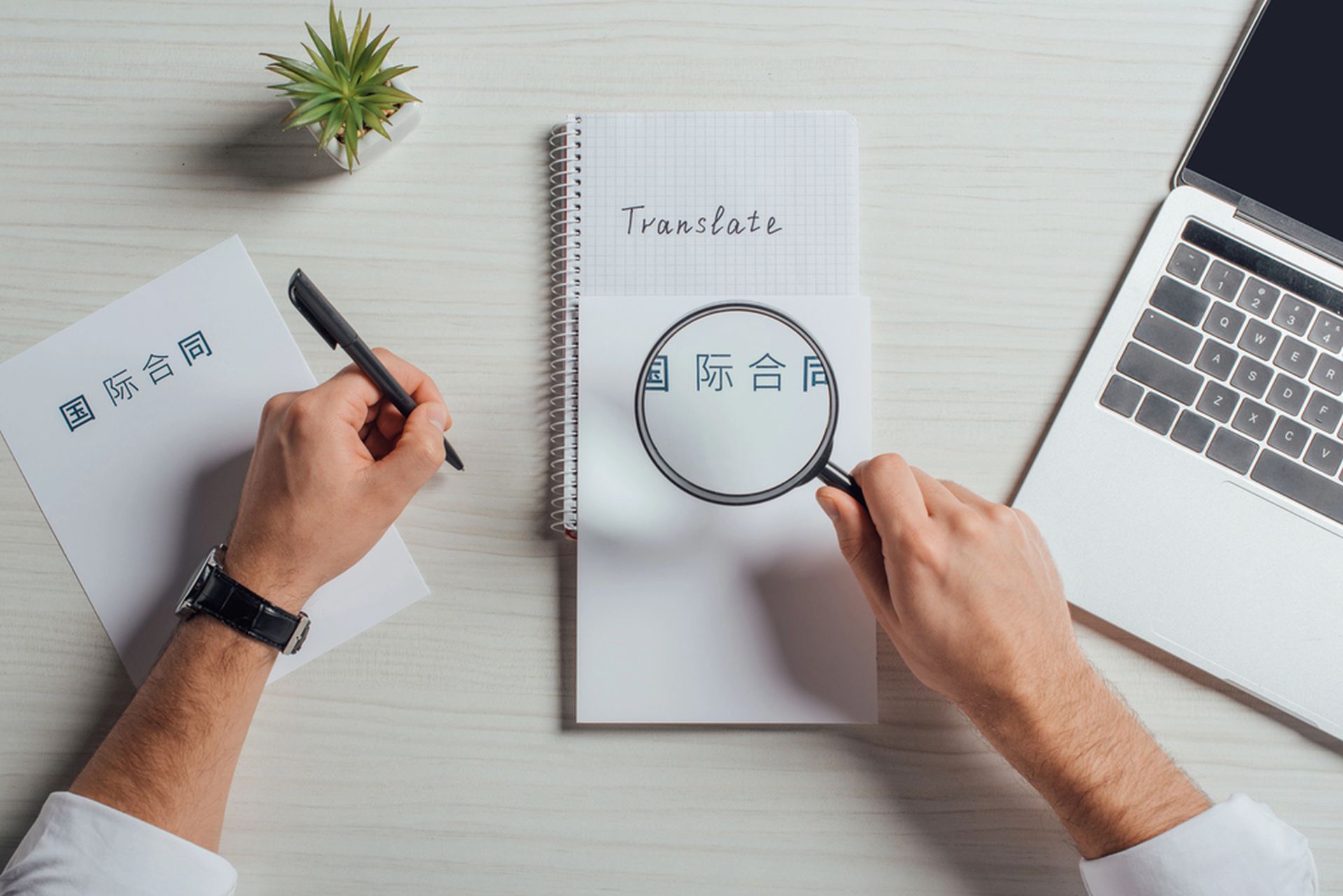
Translation is the written conversion of a document from one language to another. Interpreting is the real-time rendering of spoken communication. They require different skills, different tools, and different professionals — a qualified interpreter is not automatically a qualified translator, and vice versa.
AccessBridge provides both services. If your organization needs a translated IEP document and an interpreter for the IEP meeting, we coordinate both under a single engagement. If you are uncertain which service your situation requires, contact us and we will advise.
Common questions about translation
Yes. Human-only translation, with no machine translation at any stage, is available for any project. Some organizations require it by policy, and we recommend it for legal, clinical, and other high-consequence content. Turnaround and pricing differ from MTPE and are confirmed at quote.
Sight translation is an interpreter orally rendering a written document in real time. Written translation produces a finished document in the target language, with linguist review, translation memory, and term base consistency applied. Sight translation suits short, simple documents or last-minute needs in a meeting. It leaves the family with no written record to review or keep, and it is not a substitute where the law requires a written translation. For IEPs, evaluations, consent forms, and other vital documents, we recommend written translation, with an interpreter present at the meeting to discuss it.
No. Mandarin and Cantonese are spoken languages, and speakers of one generally cannot understand the other. Simplified and Traditional are written forms. Speakers of either language may read either script, depending on where they learned to read, so the spoken language alone does not tell you which script to use. In practice, interpreting is requested by spoken language (Mandarin or Cantonese), and translation is requested by script (Simplified or Traditional).
Language access compliance
For organizations receiving federal funding or serving the public, translation is not only a quality consideration — it is a legal obligation in many contexts.
Title VI of the Civil Rights Act requires that recipients of federal financial assistance provide meaningful access to their programs and services for individuals with limited English proficiency. For school districts, government agencies, healthcare organizations, and federally funded nonprofits, this includes translating vital documents into the languages spoken by their communities.
Executive Order 13166 directs federal agencies and their recipients to improve access to services for persons with limited English proficiency, and establishes expectations for written translation of important documents.
FERPA protects the confidentiality of student education records. When AccessBridge translates education records, we handle them as a contracted service provider acting at the district’s direction, use them only to perform the translation, and share them only with the staff and contracted professionals assigned to the work.
California Education Code imposes specific translation obligations on school districts — including translation of IEP-related documents and notices to parents in their primary language, including a translated copy of the IEP and related documents upon a parent’s request.
AccessBridge helps organizations meet these obligations with documented translation workflows, linguist credentials available on request, and project records that support compliance reporting.
Request a translation quote
Tell us about your project — document type, language pair, volume, deadline, and any subject-matter context — and we will confirm the right workflow, turnaround, and pricing for your needs.