Access services for every need
AccessBridge provides the full spectrum of communication access — from ASL interpreting and CART captioning to tactile interpreting, Braille, language interpreting, and certified translation. One trusted partner for every access requirement your organization faces.
Communication access is not a single service.
Deaf individuals may need a certified ASL interpreter. A hard-of-hearing student in a mainstream classroom may need CART captioning. A DeafBlind client may need tactile interpreting or documents in Braille or large print. A Spanish-speaking parent in an IEP meeting needs a qualified spoken language interpreter. A legal firm processing foreign-language documents needs certified translation.
AccessBridge is built to serve all of these needs — under one roof, with credentialed professionals, and with the compliance documentation your organization requires. Whatever the setting, whatever the modality, access should never be a barrier.

Our access services

American Sign Language (ASL) Interpreting
AccessBridge prioritizes RID-certified ASL interpreters for all assignments. We serve legal proceedings, education settings, healthcare appointments, nonprofit meetings, government agencies, and workplace engagements — on-site, via video remote interpreting (VRI), and in virtual meeting environments.
We also place Certified Deaf Interpreters (CDIs) for assignments requiring a Deaf interpreter's cultural and linguistic expertise, including complex legal proceedings and mental health settings.
Settings we serve: IEP and IFSP meetings, parent-teacher conferences, medical appointments, informed consent conversations, depositions, trials and hearings, board meetings, self-determination meetings, employment matters, and public agency proceedings.

CART Captioning
Communication Access Realtime Translation (CART) provides verbatim, real-time captions of spoken content — delivered on a screen, monitor, or personal device. CART is used by Deaf and hard-of-hearing individuals who prefer text over sign language interpretation, as well as by individuals who use both depending on the setting.
CART is compliant with ADA Title II and III, Section 504, and Section 508, and is increasingly required in education, legal, and government contexts. AccessBridge provides both on-site and remote CART captioning.
Settings we serve: Courtrooms and hearings, classrooms and lectures, conferences and events, healthcare settings, workplace meetings, government and public agency proceedings, and virtual environments.

Tactile Interpreting
Tactile interpreting provides communication access for DeafBlind individuals through hand-under-hand or ProTactile methods — the interpreter's signs are received through touch rather than sight. This is the primary access method for individuals who are both Deaf and have significant vision loss.
AccessBridge places qualified tactile interpreters for formal settings including legal proceedings, medical appointments, regional center and self-determination meetings, educational settings, and community events.
Settings we serve: Legal proceedings, medical appointments, IPP and IFSP meetings, regional center engagements, educational settings, community events, and social service appointments.
Alternative Format Services
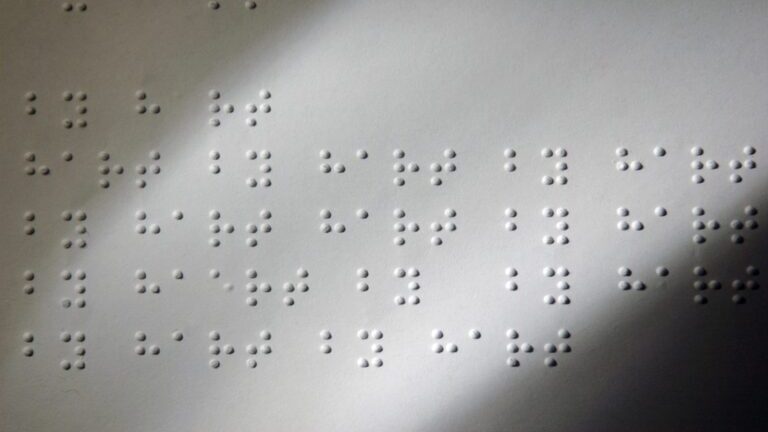
Written materials are only accessible if they can be read in a format that works for the individual. For DeafBlind and blind individuals who read Braille, and for individuals with low vision who require large print, documents provided only in standard print or digital formats create a direct access barrier — and in many contexts a compliance failure under the ADA and Section 508.
AccessBridge provides Braille transcription and large print production from a single source document, reducing turnaround time for organizations that need multiple formats simultaneously.
Braille services include contracted (Grade 2) and uncontracted (Grade 1) transcription, with output as embossed hard copy or electronic Braille file (BRF). Large print services produce documents at client-specified sizes — typically 18pt minimum — with formatting and layout preserved.
Materials we produce: Legal documents and case materials, IEPs and evaluation reports, medical records and discharge instructions, organizational handbooks and policies, government and agency correspondence, educational curricula and assessments.

Language Interpreting
AccessBridge provides professional spoken language interpretation in over 240 languages — face-to-face, over-the-phone (OPI), and via video remote. Our interpreters bring subject-matter expertise in legal, education, healthcare, and nonprofit settings, ensuring that linguistic access does not become a liability.
All interpreters are vetted, background-checked, and matched to your assignment's specific language, setting, and credential requirements.
Settings we serve: Depositions and deposition preparation, trials and hearings, IMEs and PQMs, IEP and ELAC meetings, parent-teacher conferences, board and town hall meetings, medical appointments, nonprofit workshops, and immigration matters.

Certified Translation
Accurate translation is not word-for-word substitution — it is the faithful transfer of meaning, context, and legal standing from one language to another. AccessBridge provides certified translation for legal documents, educational records, medical materials, and official correspondence across major languages.
Our translators bring localization expertise and subject-matter knowledge, ensuring that translated documents hold up in legal proceedings, school admissions, immigration matters, and government submissions.
Documents we translate: Legal pleadings and case materials, IEPs and school records, birth certificates and vital records, medical records and clinical summaries, immigration documents, organizational policies and handbooks, and psychological and educational evaluations.
Serving the sectors where
access is non-negotiable
Access failures in education, legal, healthcare, and nonprofit settings are not inconveniences — they are compliance failures, legal liabilities, and barriers to the rights of the people your organization serves. AccessBridge understands the specific access obligations in each sector and provides the right service, credential, and documentation for your context.

One provider,
full compliance coverage
AccessBridge helps organizations meet communication access obligations across the full framework of federal and California law:
- Americans with Disabilities Act (ADA) — Titles II and III
- Section 504 of the Rehabilitation Act
- Section 508 of the Workforce Rehabilitation Act
- Individuals with Disabilities Education Act (IDEA)
- California Education Code
- California Government Code Section 11435
- Title VI of the Civil Rights Act (language access)
We provide credential documentation, booking confirmation, and interpreter qualification records to support your organization’s compliance recordkeeping.
What working with AccessBridge looks like
Matched to your setting
Every assignment is matched to the right credential, modality, and language for your specific context. A legal deposition requires different qualifications than a community workshop. We ask the right questions before we place anyone.
Transparent credentials
We disclose interpreter and provider qualifications before every assignment. You know who is coming, what they are certified in, and what their relevant experience is — before the appointment, not after.
Documented for your records
Booking confirmations, interpreter credentials, and scheduling details are provided in a format that supports your organization’s compliance documentation requirements.
Tell us what you need.
Whether you need an ASL interpreter for a deposition next week, CART captioning for an ongoing class, or certified translation of a medical record, the process starts with a conversation.