Communication Access for Legal Proceedings
RID-certified ASL interpreters, CART captioning, certified translation, and spoken language interpretation for depositions, trials, hearings, and legal consultations across California.
In legal proceedings, communication access is the difference between justice and its absence.
Every party in a legal proceeding — witness, plaintiff, defendant, juror, or client — has the right to fully understand what is being said and to have their communication accurately conveyed to others. When that access fails, the integrity of the proceeding fails with it. A mistranslated deposition answer, an unqualified interpreter in a criminal hearing, or a Deaf client who cannot follow their own case are not procedural inconveniences — they are due process failures.
California law and federal law impose specific, enforceable obligations on legal professionals, courts, and institutions to provide qualified communication access. AccessBridge serves California’s legal community with the full range of access services that those obligations require — spoken language interpretation, ASL interpreting, CART captioning, tactile interpreting, certified translation, and alternative format document production — under a single professional relationship.

Access services for every legal context

ASL Interpreting for Legal Proceedings
Deaf and hard-of-hearing parties, witnesses, jurors, and clients have the right to full and equal access in legal proceedings. AccessBridge prioritizes RID-certified ASL interpreters for all legal assignments and places Certified Deaf Interpreters (CDIs) for complex proceedings where a Deaf interpreter's cultural and linguistic expertise improves accuracy and reduces risk.
Legal ASL interpreting requires more than general interpreting competence. Depositions, trials, and hearings involve specialized legal terminology, formal register, and high-stakes accuracy requirements. We match interpreters to legal assignments based on legal subject-matter experience — not simply ASL fluency.
Assignments: Depositions and deposition preparation, trials and hearings, arbitration, client consultations, witness preparation, preliminary hearings, arraignments, sentencing, and appeals.

CART Captioning for Legal Proceedings
For Deaf and hard-of-hearing individuals who prefer text-based access — including late-deafened adults, oral communicators, and cochlear implant users — CART captioning provides verbatim, real-time transcription of all spoken content in the proceeding. CART output can be displayed on a personal device or a dedicated monitor positioned for the individual.
CART session transcripts are saved and can be provided to the individual after the proceeding — a verbatim record that supplements the official court reporter's transcript and supports review of testimony and argument.
Assignments: Depositions, hearings, client meetings, arbitration, and any proceeding where a Deaf or hard-of-hearing party or counsel requires text-based access.

Spoken Language Interpretation for Legal Proceedings
California's legal proceedings involve the full range of languages spoken by its communities. AccessBridge provides professional spoken language interpreters for legal settings in over 240 languages — matched to the specific proceeding type, subject matter, and credential requirements.
For California superior court proceedings, we place interpreters holding the California Court Interpreter credential where required under California Rules of Court. For federal proceedings, we place interpreters with appropriate federal court certification. Interpreter credentials are available to counsel and court administrators on request.
Assignments: Depositions and deposition preparation, trials and hearings, IMEs and PQMEs, witness statements, client consultations, immigration hearings, workers' compensation proceedings, criminal and civil matters, and arbitration.
Certified Translation for Legal Documents
Accurate legal translation requires subject-matter expertise, terminological precision, and an understanding of the legal systems involved. AccessBridge provides certified translation of legal documents for use in California courts, federal proceedings, immigration matters, and international legal contexts.
All translations are produced using professional MTPE workflows with qualified legal translators, translation memory for terminological consistency, and a controlled term base for legal vocabulary. Certification statements are provided for documents requiring official certification.
Documents: Pleadings and motions, deposition transcripts, witness statements, contracts and agreements, immigration filings, vital records, foreign-language evidence, legal correspondence, and court orders.

Tactile Interpreting for DeafBlind Parties
DeafBlind individuals involved in legal proceedings require tactile interpreting — communication access through touch — provided by an interpreter specifically trained in tactile methods. A standard ASL interpreter cannot provide effective communication access for a DeafBlind party. AccessBridge places qualified tactile interpreters for legal assignments and coordinates Support Service Provider (SSP) services where environmental access is also needed.
Assignments: Any legal proceeding involving a DeafBlind party, witness, or client.
Alternative Format Documents
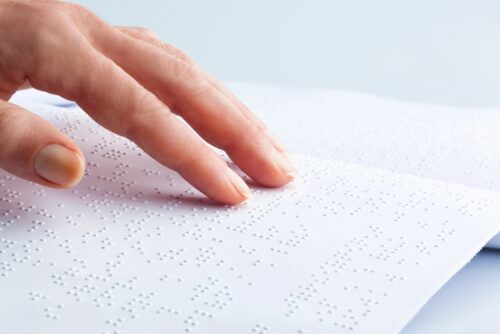
Legal documents — pleadings, notices, orders, case materials — must be accessible to blind and DeafBlind parties and counsel. AccessBridge produces Braille transcription and large print versions of legal documents from your source files, with turnaround times designed for legal deadlines.
Documents: Pleadings, notices, deposition materials, evidence, correspondence, and case-related documents.
Legal settings we serve
- Depositions and deposition preparation
- Trials and courtroom proceedings
- Hearings and preliminary proceedings
- Arraignments and sentencing
- Arbitration and mediation
- Client consultations and intake
- Witness preparation and interviews
- Immigration hearings and consultations
- Workers’ compensation proceedings
- Personal injury and civil matters
- Criminal defense proceedings
- Family law proceedings
- Appellate proceedings
- Law enforcement interviews
- Administrative and agency hearings
- Independent medical examinations (IMEs) and PQMEs
- Legal aid and public defender services
Legal compliance framework
Americans with Disabilities Act — Titles II and III Courts and government entities are covered by Title II, which requires effective communication access for Deaf, hard-of-hearing, and DeafBlind parties and witnesses. Private legal offices and law firms are covered by Title III as places of public accommodation. For a Deaf client in a legal consultation, the law firm’s obligation to provide communication access is direct and enforceable.
California Rules of Court — Rule 2.890 and Related Provisions California Rules of Court establish interpreter qualifications and procedures for court proceedings. Rule 2.890 governs the appointment and conduct of spoken language interpreters in civil proceedings. Separate provisions govern interpreters in criminal proceedings and administrative hearings. AccessBridge places interpreters who meet California Rules of Court credential requirements for court-governed assignments.
California Government Code Section 11435 Establishes interpreter qualifications and standards for state administrative proceedings — including requirements that interpreters be certified or otherwise qualified to a documented standard.
ADA Title II — Effective Communication For Deaf parties in court proceedings, the effective communication standard requires a qualified interpreter — not simply any available bilingual person. Courts that provide underqualified interpreters do not satisfy their ADA obligation. AccessBridge’s RID-certification preference for ASL interpreters and court-credential matching for spoken language interpreters directly supports this standard.
Title VI of the Civil Rights Act Courts and legal service providers receiving federal funding must provide meaningful language access for individuals with limited English proficiency. Providing a qualified interpreter at no cost to the LEP party is a Title VI requirement in most federally funded legal contexts.
Why interpreter credentials matter specifically in legal settings
Legal proceedings carry consequences that most other settings do not. A deposition answer rendered inaccurately by an underqualified interpreter can affect a case outcome. A Deaf defendant who cannot follow proceedings through an unqualified interpreter is being denied due process. A translated document with terminological errors can misrepresent a contract, a record, or a party’s statement.
The consequences of communication access failure in legal settings are not abstract — they are appealable, litigable, and in criminal contexts, constitutional. This is why AccessBridge approaches legal assignments with credential specificity that goes beyond general professional standards.
For ASL interpreting, we prioritize RID certification and match legal experience to the proceeding type. For spoken language court interpreting, we place credentialed court interpreters where California Rules of Court require them. For translation, we match legal translators with documented subject-matter competence. For tactile interpreting, we place only interpreters with specific tactile training — not ASL interpreters reassigned to a role they are not trained for.
Interpreter and translator credentials are available to counsel and court administrators on request before every assignment.
Common questions about legal interpreting and access services
Request legal interpreting or access services
Tell us about the proceeding — type, language or access need, date, location, and any credential requirements — and we will confirm the right placement and credentials before the assignment.