Tactile Interpreting Services
Communication and environmental access for Deaf-Blind individuals — qualified tactile interpreters and Support Service Providers for legal, education, healthcare, nonprofit, and government settings across California.
Placing a standard ASL interpreter with a DeafBlind individual doesn't fulfill your obligation. Under the ADA, it creates one.
Deaf-Blind individuals — those who have combined hearing and vision loss to varying degrees — face access barriers that neither standard ASL interpreting nor spoken language interpretation can adequately address. Visual sign language interpretation is inaccessible to someone who cannot see the interpreter. Audio is inaccessible to someone who cannot hear. Tactile interpreting addresses this directly: communication is received through touch, with the interpreter’s signs conveyed through the Deaf-Blind individual’s hands rather than through sight or sound.
Tactile interpreting is a specialized skill distinct from visual ASL interpreting. It requires specific training, familiarity with tactile communication methods, and experience working with Deaf-Blind individuals across a range of vision and hearing loss profiles. AccessBridge places qualified tactile interpreters and Support Service Providers for Deaf-Blind individuals in formal and community settings across California.


What tactile interpreting is and how it works
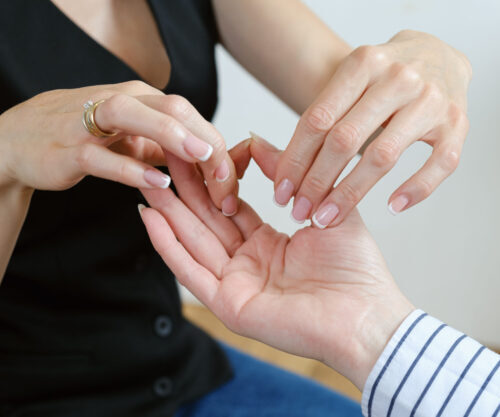
Tactile interpreting is interpreting received through touch. The Deaf-Blind individual places their hands on or under the interpreter’s hands to receive signs through tactile feedback rather than visual observation. The interpreter signs into the hands of the individual, who reads the signs through the sensation of the interpreter’s hand shapes, movements, and locations.
There are several established methods of tactile communication, and the preferred method varies by individual — based on their degree of vision loss, their communication background, and their personal preference. Qualified tactile interpreters are trained across multiple methods and adapt to the individual’s needs.
Primary tactile communication methods:
Hand-Under-Hand (HUH)
The Deaf-Blind individual places their hands under the interpreter’s hands and reads the interpreter’s signs through tactile contact. The most widely used method for individuals who are fluent in ASL and have acquired Deaf-Blindness after developing sign language skills.
ProTactile (PT)
An evolving communication framework developed within and by the Deaf-Blind community. ProTactile expands on hand-under-hand technique to include back-channeling — tactile feedback to the Deaf-Blind individual indicating reactions, environmental information, and conversational signals — and a growing vocabulary of ProTactile-specific signs. ProTactile is increasingly the preferred framework among Deaf-Blind individuals who are active in the Deaf-Blind community.
Tactile Fingerspelling
Letter-by-letter communication spelled into the Deaf-Blind individual’s palm or hand. Used for proper nouns, unfamiliar terms, and as a supplemental method alongside other tactile communication.
Print on Palm
Block letters written directly onto the Deaf-Blind individual’s palm. Used for brief, simple communications and in situations where the individual does not have a shared sign language background with the interpreter.
Support Service Providers
(SSPs)
Tactile interpreting addresses communication access. Environmental access is a separate but equally essential need for many Deaf-Blind individuals — navigating physical environments, accessing incidental visual information, and participating in the social dimensions of settings where they are present.
Support Service Providers (SSPs) assist Deaf-Blind individuals with environmental navigation and social access. An SSP describes the physical environment, conveys visual information not captured in formal interpretation — facial expressions, body language, written text in the room — guides navigation through unfamiliar spaces, and provides the contextual awareness that allows a Deaf-Blind individual to fully participate in a setting rather than simply receive interpreted communication.
SSPs are not interpreters, and interpreters are not SSPs. In complex formal settings — legal proceedings, medical appointments, multi-participant meetings — a Deaf-Blind individual may require both a tactile interpreter and an SSP simultaneously. AccessBridge coordinates both roles and can provide a single booking point for assignments requiring both services.
Settings we serve
- Legal depositions and proceedings
- Trials, hearings, and arbitration
- Medical appointments and informed consent
- Mental health and therapy sessions
- IEP meetings
- Educational settings and assessments
- Social service and benefits interviews
- Nonprofit board and community meetings
- Government and public agency proceedings
- Employment interviews and workplace meetings
- Community events and social gatherings
- Deposition preparation and legal consultations
- Hospital and clinical settings

Understanding Deaf-Blindness
Deaf-Blindness is not a single, uniform condition. It encompasses a wide spectrum of combined vision and hearing loss — from individuals who are totally blind and profoundly Deaf, to those with significant but partial vision and hearing. The communication needs and preferred access methods of Deaf-Blind individuals vary accordingly.
Common causes of Deaf-Blindness include Usher Syndrome — a genetic condition that causes congenital or early-onset deafness combined with progressive vision loss — as well as age-related combined sensory loss, acquired brain injury, premature birth, and other medical causes. The communication background of the individual — whether they grew up Deaf and signing, hearing and speaking, or with some combination — significantly affects which tactile communication method is most appropriate.
This is why intake information matters. When booking a tactile interpreter, providing as much information as possible about the individual’s communication background, preferred method, degree of vision and hearing loss, and any previous interpreter preferences allows us to make the best possible placement. A qualified tactile interpreter is not interchangeable with a visual ASL interpreter — the skill set, the method, and the relational approach are distinct.
Legal obligations for Deaf-Blind individuals
The communication access rights that apply to Deaf individuals under the ADA, Section 504, and IDEA apply equally to Deaf-Blind individuals — and in many cases carry additional obligations given the complexity of providing effective access across combined sensory loss.
Americans with Disabilities Act — Titles II and III Government entities and places of public accommodation must provide effective communication access for Deaf-Blind individuals. For most formal interactions, this means providing a qualified tactile interpreter — not a standard ASL interpreter who is not trained in tactile methods.
Section 504 of the Rehabilitation Act Federally funded organizations must ensure program access. For Deaf-Blind students and clients, this includes access through tactile interpreting and SSP services as appropriate to the individual’s needs.
IDEA — Individuals with Disabilities Education Act Deaf-Blind students have the right to a free appropriate public education in the least restrictive environment. Communication access through qualified tactile interpreting is a component of the individualized education program for many Deaf-Blind students.
The Helen Keller National Center Act Federal legislation specifically recognizing the access needs of Deaf-Blind individuals and establishing national standards for Deaf-Blind services, including communication access.
A critical compliance note: providing a standard ASL interpreter who is not trained in tactile methods does not satisfy the effective communication obligation for a Deaf-Blind individual who requires tactile access. The ADA’s standard is effectiveness — not the provision of any interpreter. Placing an unqualified interpreter creates both an access failure and a legal liability.
Common questions about tactile interpreting
Request a tactile interpreter or SSP
Tell us about the individual’s communication needs, the setting, the date, and any specific method preferences — and we will confirm the right placement.